

By Evan Kowalski · Editor
Published · Updated
Answer in brief
Insurers rate the last three to five years of your record. A minor speeding ticket adds roughly 10–25%, an at-fault accident 30–60%, and a DUI 60–100% or more, each for about three years. Multiple incidents compound and can move you from a preferred tier to a standard or non-standard one, where base rates are far higher. Not-at-fault accidents and comprehensive claims usually carry no surcharge. The surcharge expires on schedule if the record stays clean—and insurers with shorter lookbacks drop it sooner.
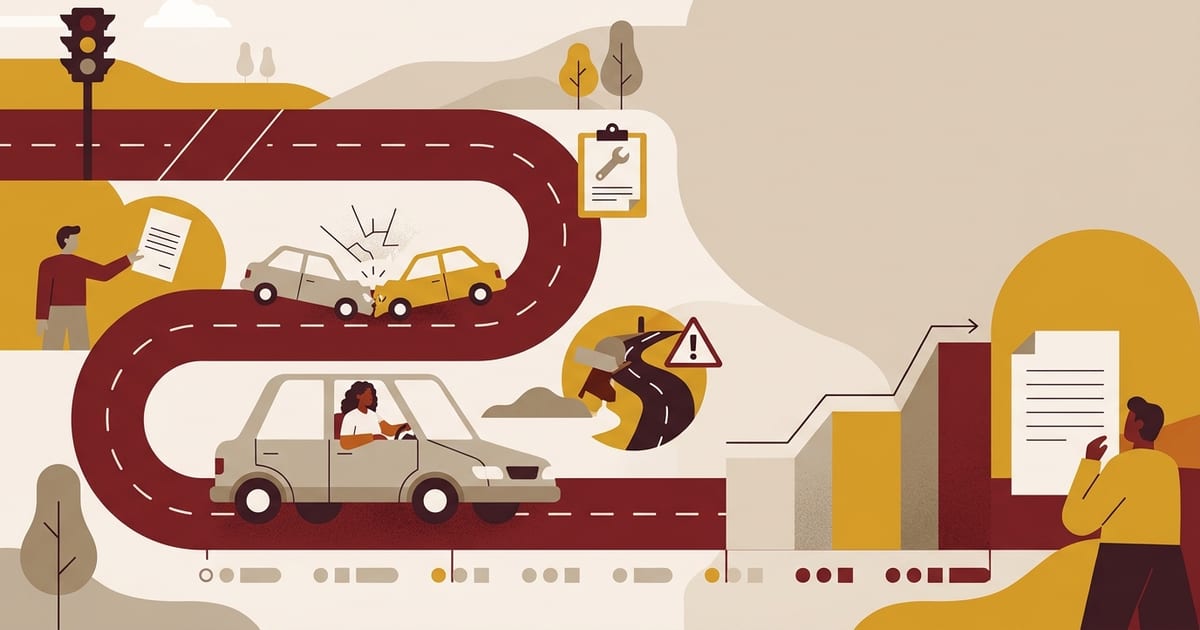
Typical surcharges
| Event | Typical increase | Typical duration |
|---|---|---|
| Minor speeding (under 15 over) | 10–25% | 3 years |
| Major speeding / reckless | 30–70% | 3–5 years |
| At-fault accident | 30–60% | 3 years (some 5) |
| Second at-fault accident | Often tier change; 80%+ | 3–5 years |
| DUI | 60–100%+ | 3–5 years; 10 in some states |
| Not-at-fault accident | Usually none | — |
| Comprehensive claim (glass, theft, weather) | Usually none; frequency may matter | — |
Lookback periods
Each insurer decides how far back to look—three years and five years are common. In years four and five after an incident, this one choice can be the largest factor in your premium, which is why comparing at those renewals often finds a much lower price with an insurer that no longer counts the event.
Tiers
Beyond surcharges, insurers sort drivers into tiers (preferred, standard, non-standard) with different base rates. Two incidents in three years often move you down a tier, and the tier change can cost more than the surcharges themselves.
Quote finder
Find auto insurance quotes that fit your situation
Recovering
Time and a clean record do most of the work. Defensive-driving courses remove points or earn discounts in many states; telematics proves current behaviour. See how to lower.
Entries in this guide
Specific questions answered in more depth.
Questions & answers
How long does an accident affect my insurance?
Typically three years; some insurers consider it for five.
Does a ticket I paid still count?
Paying a ticket is a conviction. It appears on your record and most insurers rate it.
Will my insurer find out about a ticket?
Insurers pull motor vehicle records at renewal and sometimes at other times. Most tickets are found.
Terms used in this guide
- Surcharge
- A percentage added to the premium for an at-fault accident or violation, typically for three years.
- Lookback period
- How many years of record an insurer rates—three and five are common.
- Rating tier
- A grouping (preferred, standard, non-standard) with its own base rates. Record, credit and history determine your tier.
- At-fault accident
- A crash the insurer determines you caused. Surcharged; not-at-fault accidents usually are not.
Sources and references
Legal figures on this page (minimum limits, filing periods, statutory benefits) are checked against the primary law or the state insurance regulator listed below. Links and figures last verified Nov 2026.
- Speed — Insurance Institute for Highway SafetyIndependent researchHow speed raises crash likelihood and severity; speed-limit and enforcement research.
- Facts + Statistics: Alcohol-impaired driving — Insurance Information InstituteStatistical dataAlcohol-impaired crash fatalities, BAC thresholds and state ignition-interlock context.
- Facts + Statistics: Highway safety — Insurance Information InstituteStatistical dataCrash, injury and fatality trends used to explain why liability and injury coverages cost what they do.
- What determines the price of an auto insurance policy? — Insurance Information InstituteConsumer guidanceRating factors: driving record, mileage, location, age, gender, vehicle, credit-based insurance score, coverage choices. Notes ZIP-code rating is prohibited in California and Michigan and gender rating is prohibited in seven states.
- Nine ways to lower your auto insurance costs — Insurance Information InstituteConsumer guidanceShop at least three quotes; raising a deductible from $200 to $500 can cut collision/comprehensive cost 15–30%, $1,000 can save 40%+; drop physical damage on cars worth under 10× the premium; bundling, low-mileage and good-student discounts.
- How to file an auto insurance claim — Insurance Information InstituteConsumer guidanceSteps after a crash: document the scene, notify the insurer promptly, understand the adjuster's role.
- Understanding your insurance deductibles — Insurance Information InstituteConsumer guidanceHow deductibles apply to collision and comprehensive and how raising them lowers premium.
Practical guidance on this page is original editorial work. Cited sources support factual statements and do not endorse this site. Dollar ranges described as typical or illustrative are editorial estimates, not figures from these sources.
Guide
The 12 Reasons Car Insurance Rates Are High
Every factor that sets a car insurance premium—record, age, location, vehicle, credit, coverage, market trends—ranked by how much each one typically moves the price.
Guide
How to Lower Car Insurance That Is Too High
A prioritised list of actions that lower a high premium—comparing, coverage changes, deductibles, telematics, discounts, vehicle and mileage—with realistic savings.
Guide
When to Switch Car Insurance Companies
How to decide whether to switch insurers after a rate increase, when the best moments are, how to avoid a lapse, and what loyalty is actually worth.