

By Naomi Feld · Research Writer
Published · Updated
Answer in brief
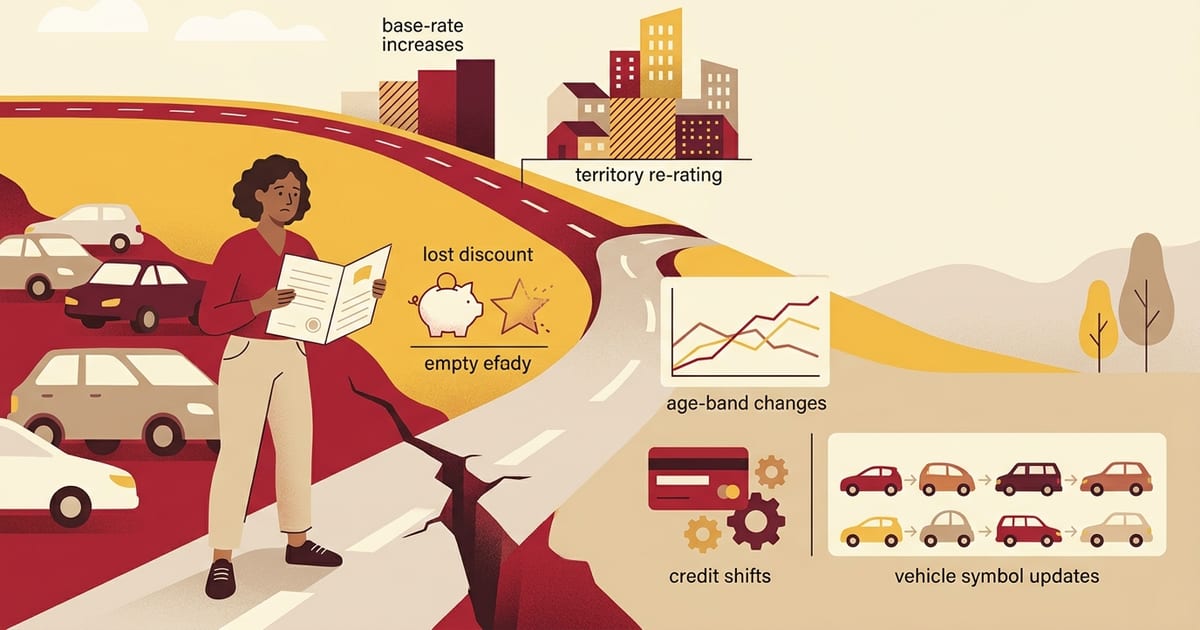
A renewal increase with no claims or tickets almost always has one of six causes: an insurer-wide base-rate increase approved by your state (the most common since 2021), a territory re-rating of your ZIP code, a lost discount (claim-free, bundling, paperless, telematics), an age-band change, a credit-based score shift, or a change in your vehicle's rating symbol. None is personal; all are fixable or shoppable. Comparing quotes after a no-reason increase is the single most productive response.
1. Base-rate increases
Insurers file rate changes with state regulators when their claim costs change. Since 2021, used-vehicle values, parts prices, repair labour, medical costs and injury-claim litigation have all risen sharply, and the industry filed a wave of increases—often 10–25% a year in many states. These apply to every policyholder in the affected territories regardless of record. If your increase matches what friends with the same insurer saw, this is the cause.
2. Territory re-rating
Insurers periodically update the relative rates of their rating territories. If your ZIP code's claim experience worsened relative to the rest of the state—more crashes, more theft, more weather—its factor rises.
3. Lost discounts
Claim-free and accident-free discounts can disappear after a not-at-fault claim with some insurers. Bundling discounts vanish if a home or renters policy moved. Telematics discounts adjust at renewal with your score. Paperless and autopay discounts drop if a card expired. Compare the discount list on your old and new declarations pages.
4. Age-band changes
Rates generally fall with age until the mid-fifties and then begin to rise again, often noticeably after 70. A birthday that crosses a band boundary changes the premium without any other event.
5. Credit-based insurance score
In most states insurers re-check an insurance score at renewal. A new credit account, a higher utilisation ratio or a missed payment can lower the score and raise the premium. States that restrict credit in rating are listed in the credit guide.
Quote finder
Find auto insurance quotes that fit your situation
6. Vehicle symbol updates
Rating symbols for your make and model are updated as claims data accumulates. A model that proves expensive to repair or popular with thieves gets a higher symbol, raising collision and comprehensive premiums for everyone who owns one.
Questions & answers
Can my insurer raise my rate for no reason?
Rates can only change under an approved filing or a change in your rating factors—but neither requires a claim or ticket from you.
Why did everyone's insurance go up?
Industry-wide claim costs rose sharply after 2021—repairs, vehicle values, medical and litigation—and insurers filed base-rate increases to match.
Will rates come back down?
Base rates rarely fall, but increases have moderated in many states as insurers caught up with costs. Comparing is the reliable way to lower your own.
Terms used in this guide
- Base rate
- The starting premium for a coverage in a territory before individual factors and discounts.
- Rate filing
- An insurer's submission to a state regulator to change its rates. Approved filings apply to all policyholders in the affected territories.
- Loss trend
- The rate at which claim costs are rising over time—repairs, vehicle values, medical, litigation. The main driver of base-rate increases.
- Rating territory
- A geographic area with its own base rates, set from local claims experience.
Sources and references
Legal figures on this page (minimum limits, filing periods, statutory benefits) are checked against the primary law or the state insurance regulator listed below. Links and figures last verified Nov 2026.
- Credit-based insurance scores (insurance topic) — National Association of Insurance CommissionersState insurance regulatorIn most states insurers may not use a credit score as the sole reason to raise rates or decline, cancel or non-renew; many states require adverse-action notices.
- State chart: use of credit reports/scoring in underwriting — National Association of Insurance Commissioners (2025)State insurance regulatorState-by-state statutory summary; e.g. Massachusetts (auto rates may not be based on credit), Michigan (credit score prohibited, MCL 500.2162), Maryland (credit may rate a new auto policy only).
- Background on: Insurance scoring — Insurance Information InstituteIndependent researchWhat credit-based insurance scores are; Arkansas regulator data showing credit lowered premium on ~57% of auto policies and raised it on ~23%.
- Facts + Statistics: Auto insurance — Insurance Information Institute (2025)Statistical dataNAIC countrywide average auto expenditure: $1,127 (2022), $1,282 (2023); most expensive states in 2023 were Florida, Louisiana and New York.
- Insurance losses by make and model — Highway Loss Data InstituteStatistical dataRelative claim frequency and severity by vehicle under collision, property damage, comprehensive, PIP, MedPay and bodily injury coverages.
- What determines the price of an auto insurance policy? — Insurance Information InstituteConsumer guidanceRating factors: driving record, mileage, location, age, gender, vehicle, credit-based insurance score, coverage choices. Notes ZIP-code rating is prohibited in California and Michigan and gender rating is prohibited in seven states.
- Consumer insurance information — National Association of Insurance CommissionersConsumer guidancePlain-language guides from the body of state insurance regulators; links to every state's insurance department and complaint process.
- How to file an auto insurance claim — Insurance Information InstituteConsumer guidanceSteps after a crash: document the scene, notify the insurer promptly, understand the adjuster's role.
Practical guidance on this page is original editorial work. Cited sources support factual statements and do not endorse this site. Dollar ranges described as typical or illustrative are editorial estimates, not figures from these sources.
Guide
The 12 Reasons Car Insurance Rates Are High
Every factor that sets a car insurance premium—record, age, location, vehicle, credit, coverage, market trends—ranked by how much each one typically moves the price.
Guide
When to Switch Car Insurance Companies
How to decide whether to switch insurers after a rate increase, when the best moments are, how to avoid a lapse, and what loyalty is actually worth.
Guide
How to Lower Car Insurance That Is Too High
A prioritised list of actions that lower a high premium—comparing, coverage changes, deductibles, telematics, discounts, vehicle and mileage—with realistic savings.